As I write this, Massachusetts is watching the Lindsay Clancy trial unfold in real time. Every day another witness takes the stand. Another medical record is dissected. Another text message is analyzed. Another ordinary moment from a mother’s life is held up as evidence that she was either desperately ill or completely sane.
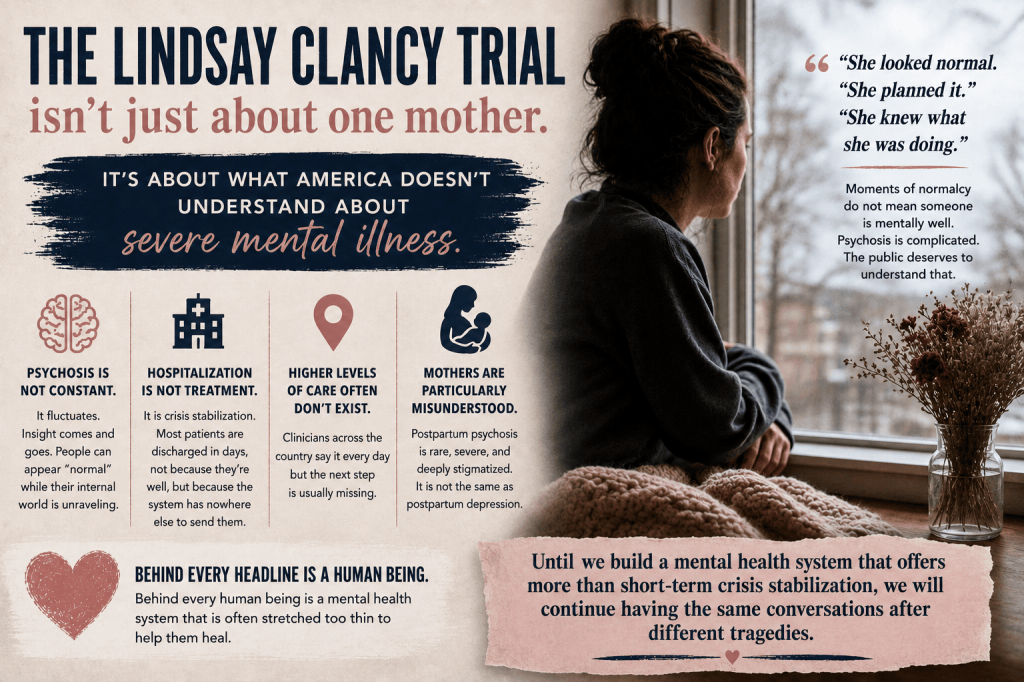
I’ve watched thousands of comments online. “She looked normal.” “She planned it.” “She texted people.” “She took a selfie.” “She knew what she was doing.” Almost overnight, millions of people became armchair psychiatrists.
Far fewer understand what psychosis actually is.
That isn’t meant as an insult. It’s an observation. Unless you’ve lived with severe mental illness yourself, loved someone through it, or spent years working alongside it, your understanding is probably shaped more by television than by clinical reality. We imagine psychosis as someone screaming in the street, completely detached from reality every second of every day. In practice, it is often much quieter, much more subtle, and infinitely more complicated.
And if you don’t understand it, thank God you don’t. With social media embedded into our everyday lives, it’s hard to remember that not every topic needs our public commentary.
I’ve spent the last few years working in addiction treatment, where mental illness and substance use collide every single day. People don’t arrive with neatly labeled diagnoses. They arrive addicted, homeless, traumatized, psychotic, paranoid, depressed, manic, or some combination of all of the above. Families bring them to us because they don’t know where else to go. Emergency departments stabilize them. Psychiatric units stabilize them. Then many arrive in programs like mine, where one phrase is repeated over and over again.
“This patient needs a higher level of care.”
Families hear that sentence and assume another door opens.
It usually doesn’t.
One of the biggest misconceptions in American mental health care is that psychiatric hospitalization is treatment. It isn’t. It is crisis stabilization. Those are not the same thing.
When someone is brought to a psychiatric hospital under an emergency hold—such as a Section 12 in Massachusetts—the purpose is to determine whether they meet the legal criteria for involuntary hospitalization because they pose an immediate risk related to mental illness. Once that immediate crisis improves enough that they no longer meet that legal threshold, they are discharged. Their schizophrenia isn’t cured. Their bipolar disorder hasn’t disappeared. Their postpartum psychosis hasn’t resolved simply because seventy-two hours have passed. The crisis may have lessened enough that continued involuntary hospitalization is no longer legally justified, but the illness itself often remains.
This surprises people because we’ve created the illusion that somewhere in America there is a place where someone can stay until they are genuinely well.
For many patients, that place simply doesn’t exist.
One man I worked with lived with schizophrenia and years of crack cocaine addiction. He was one of the kindest people I’ve ever met. Some afternoons he would argue passionately with people no one else could see. Other days he would lovingly talk to a dog that existed only in his reality. When new patients became frightened, I’d do a quick check on him and ask if everything was okay. He’d smile, tell me he was fine, and then follow me back to my office for a piece of candy while we talked about calling his sister to say hello.
That is psychosis.
Not the Hollywood version.
Not constant chaos.
Not violence.
Psychosis is a symptom that changes how a person experiences reality. Someone can be hallucinating and still remember your name. They can be paranoid and still laugh at a joke. They can carry on a perfectly coherent conversation before drifting into thoughts that no one else can follow. Their humanity doesn’t disappear because they’re psychotic.
Another patient reminded me just how invisible severe mental illness can be. He came to us struggling primarily with methamphetamine and alcohol use, but something about his presentation never sat right with me. Every morning during treatment rounds I found myself saying the same sentence: “I think he’s experiencing psychotic symptoms.”
He wasn’t yelling. He wasn’t obviously hallucinating. He laughed with peers over games of Rummy, ate meals, and, to many people, looked completely fine. But if you spent enough time with him, you noticed conversations becoming strangely fragmented. Questions were answered like riddles. Ordinary interactions were filtered through profound mistrust. You learned to phrase things carefully because reality itself seemed to shift beneath him. He refused to sign treatment plans.
One afternoon he demanded a discharge date. I explained, not for the first time, that we couldn’t give him one until he worked with his aftercare coordinator to secure his next placement. I repeated myself several times, reassuring him that no one was withholding information. His demeanor changed. His comments became indirect, coded, and increasingly threatening. Other patients laughed. They thought he was joking.
I knew he wasn’t.
Leadership ultimately sent him for emergency psychiatric evaluation. He was subsequently found to be experiencing psychosis and was sectioned 12’ed — which is a mandated commitment for mental health care for persons found to be in crises.
Another patient I worked with was a 39-year-old Asian male with severe alcohol use disorder and methamphetamine abuse. He carried diagnoses of bipolar disorder and generalized anxiety disorder, though over time his presentation raised the possibility of a schizoaffective process—something I cannot formally diagnose, but something that was always present in the background of how he moved through the world.
He experienced command hallucinations daily.
Multiple times a day.
He knew they weren’t real.
That distinction is something most people don’t understand: insight and illness can coexist. He would sit across from me, exhausted, eyes downcast, never quite able to maintain eye contact for long. His posture was guarded, his attention fractured, as if part of him was always listening to something I could not hear.
And he would talk about it with painful clarity.
He knew the voices had taken years from his life. He could trace it. He could map it. He would describe, in detail, how the hallucinations escalated during periods of sobriety, how they worsened with stress, how they became unbearable without substances. He drank and used methamphetamine not to chase euphoria, but to quiet the commands—voices telling him to kill himself, voices that never fully stopped.
He wasn’t confused about what was happening to him.
He was trapped inside it.
That kind of awareness complicates everything people think they understand about psychosis. It is not always a break from reality in the way we imagine. Sometimes it is a person fully aware that their mind is betraying them, trying to negotiate with it anyway, trying to survive inside it anyway.
That experience has stayed with me because it illustrates something the Lindsay Clancy trial has brought into sharp focus. The public often assumes that if someone can plan, text, smile, drive a car, or appear “normal,” they must not have been suffering from severe psychiatric illness.
Clinical reality is far more complicated.
Severe mental illness is rarely a straight line. Symptoms wax and wane. Insight comes and goes. People can appear organized while their internal world is profoundly disorganized. A mother can deeply love her children while simultaneously experiencing a psychiatric illness that radically distorts her perception of reality. None of that answers the legal questions in the Clancy case. Those questions belong in a courtroom and should be decided on the evidence presented there.
But the trial has exposed something much larger than one family’s tragedy.
It has exposed how little most of us understand about what severe mental illness actually looks like, what psychiatric treatment actually is, and what happens after a patient is discharged.
The truth is, healthcare staff across America say someone “needs a higher level of care” every single day. The public assumes that means there’s another hospital, another program, another expert waiting to take over.
Most of the time, there isn’t.
Until we build a system that offers more than short-term crisis stabilization—one that includes long-term psychiatric care, integrated treatment for addiction and serious mental illness, supportive housing, and specialized perinatal psychiatric services—we will continue having the same conversations after different tragedies.
We’ll continue asking why people fell through the cracks.
The harder question is whether we’ve mistaken the cracks for the system itself.
 per this writer…
Leave a comment